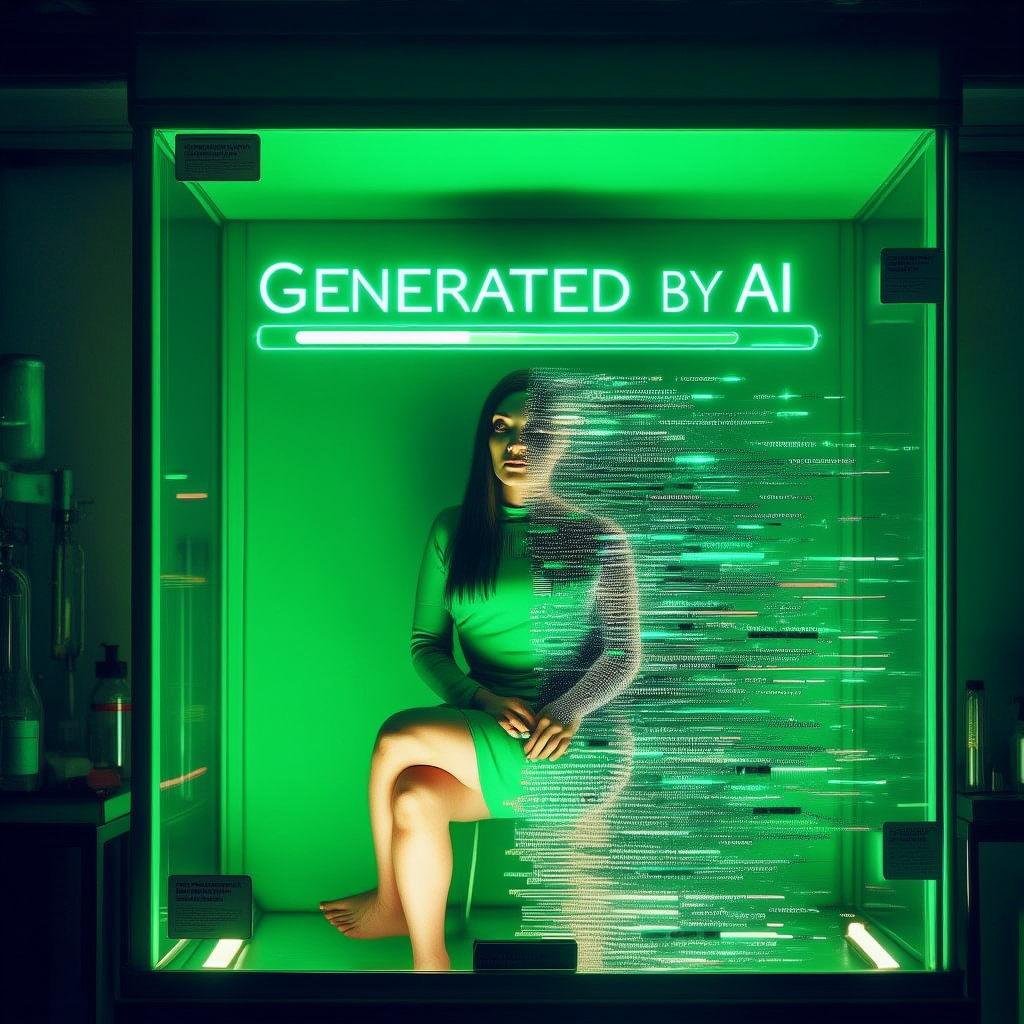
A single AI-generated video showing women sitting inside glass display cases in Medellín, Colombia — as if they were merchandise — has surpassed 9 million views across six platforms. The women don’t exist. The display cases don’t exist. The scene never happened.
But this investigation found something far more disturbing than a single viral fake. We traced the video’s origin to Bunny Honey Club, a digital agency based in Frankfurt, Germany, that operates an industrial-scale AI content pipeline producing the exact same video for cities around the world. The same template. The same glass cases. The same women reduced to objects. Only the city name and flag change.
This is not a case of Disinformation gone viral. This is a factory.
Hours after this investigation was published in spanish, the TikTok profile @arthi.king deleted all videos that evidenced the serial production of the content.
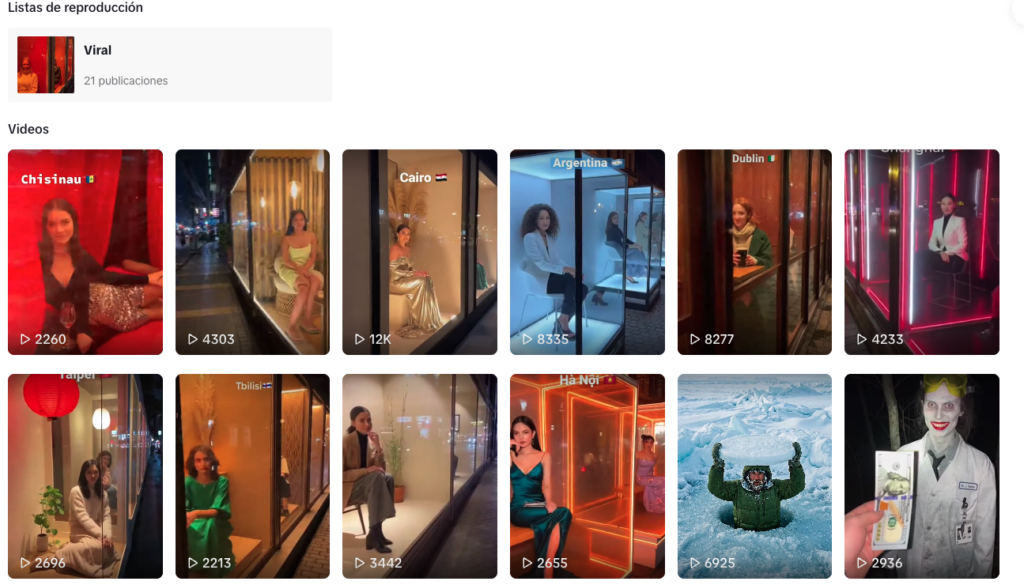
However, before they were removed, our research unit collected some videos and screenshots of the profile showing at least ten versions of the same video, each tagged with a different city: Chișinău, Cairo, Dublin, Taipei, Tbilisi, Hanoi, Argentina, and Shanghai, among others. The deletion of the content does not erase the findings; on the contrary, it reinforces the hypothesis that the producer is fully aware of the nature of the material being generated and distributed.
How We Found the Source
The investigation began with a single viral video tagged “Medellín” circulating on X (formerly Twitter), where it accumulated over 9 million views through republishers. We identified at least 12 separate posts of the same video across six platforms: X, Instagram, TikTok, Facebook, YouTube, and Kwai.
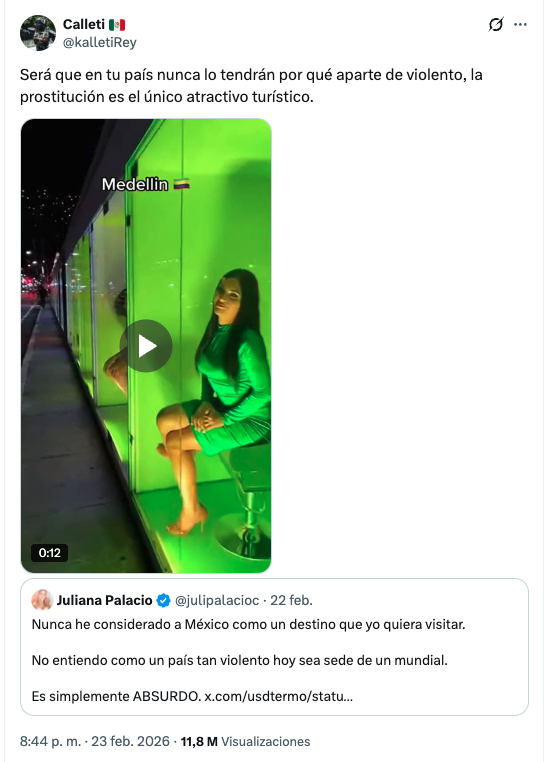
By analyzing the accounts that shared the video, we traced one publisher — the TikTok account @arthi.king — back to the original production source. Unlike the other accounts, @arthi.king didn’t just share the Medellín video. Its profile contained the same video replicated for over ten different cities worldwide. (https://www.tiktok.com/@arthi.king/video/75977908)
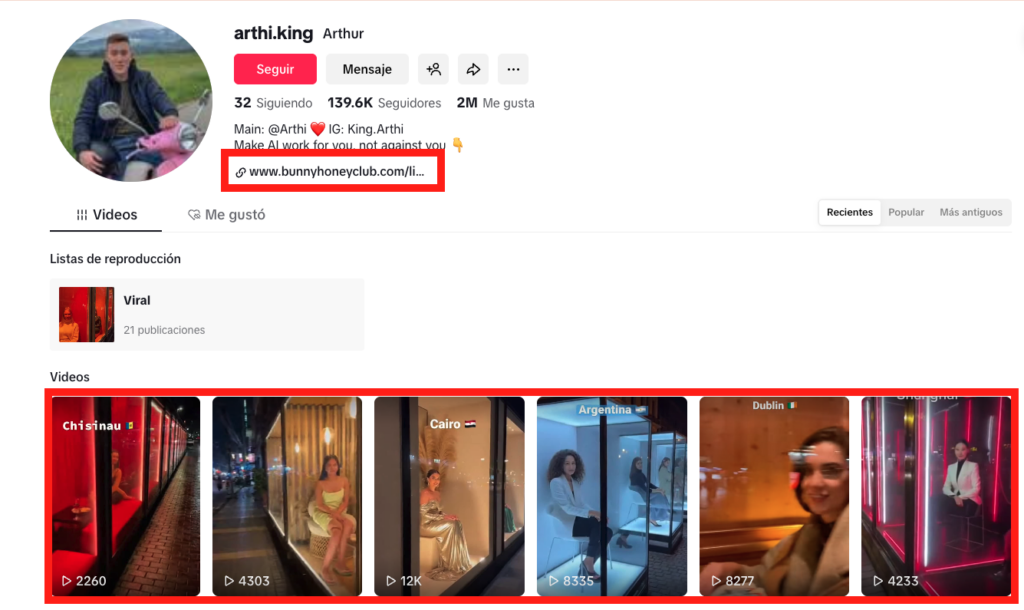
The bio of @arthi.king links directly to bunnyhoneyclub.com/links, a landing page that describes itself as “The Agency behind +10 Billion Views.” The domain bunnyhoneyclub.com is registered to Bunny Honey Agency, a business located at Heinrich-Hoffmann-Straße 6, 60528 Frankfurt am Main, Germany, with the contact number +49 163 783XXXX — the same number listed in the company’s Google Business profile, WhatsApp, and Telegram channels.
What Is Bunny Honey Club
The investigation reveals that Bunny Honey Club operates on two layers.
The current-facing layer (2026): The company presents itself as an AI automation and content production studio. Its website advertises “AI Content & Production,” “AI Workflow Automation,” and custom software development. It displays corporate testimonials and claims “$100 million in client revenue.”
The original layer: The company’s About page states that Bunny Honey is a Frankfurt-based agency whose goal is to “empower OnlyFans creators to reach financial freedom.” Its Instagram account (@bunnyhoney.club) reads: “Industry Leading Agency — Making Models to Millionaires — Become a Bunny Honey Model.” The agency claims to operate “creator hotspots” in Frankfurt, Bali, Paris, and Bangkok.
What connects both layers is the production model: the agency uses AI tools to generate visual content at massive scale, designed to go viral, and distributes it through networks of accounts across multiple platforms.
One Template, Ten-Plus Cities
The @arthi.king TikTok profile reveals the full scope of the operation. The Medellín video is not an isolated piece of content. It’s one output from an automated pipeline. We identified videos using the identical format — AI-generated women seated inside neon-lit glass display cases — tagged with the following cities:
The pattern is identical in every case: AI-generated women, seated in glass cubicles lit with colored neon, in scenes designed to look like real street-level footage. The only variable is the city name and flag overlay.
This confirms an automated production pipeline: the same AI prompt or template generates multiple localized versions of the video, each targeting a different geographic market.
One Template, Ten-Plus Cities
AI-generated videos produced by @arthi.king (TikTok), linked to Bunny Honey Club, Frankfurt, Germany
| # | City | Country | Views on @arthi.king | Status |
|---|---|---|---|---|
| 1 | Chișinău | Moldova | Deleted | |
| 2 | Unlabeled | — | Deleted | |
| 3 | Cairo | Egypt | Deleted | |
| 4 | Unlabeled | — | Deleted | |
| 5 | Argentina | Argentina | Deleted | |
| 6 | Dublin | Ireland | Deleted | |
| 7 | Taipei | Taiwan | Deleted | |
| 8 | Tbilisi | Georgia | Deleted | |
| 9 | Hanoi | Vietnam | Deleted | |
| 10 | Shanghai | China | Deleted | |
| 11 | 3 additional unlabeled | — | Deleted | |
| 12 | Medellín | Colombia | On republisher accounts Viral | |
| 13 | Rio de Janeiro | Brazil | Identified separately | |
| Total identified | 10+ countries | Medellín count from republisher accounts only |
Investigation by HyperConectado — Disinformation detection and purpose-driven digital communication.
Signs of Synthetic Content
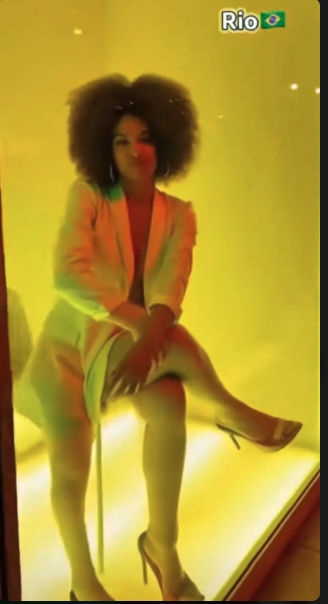
For the average social media user, the synthetic nature of the video is not immediately obvious. However, frame-by-frame analysis reveals clear AI generation artifacts:
- The avatars have no legs or severely deformed lower limbs.
- Body proportions are inconsistent and shift between frames.
- Glass reflections don’t match the geometry of the scene.
These are hallmarks of low-quality synthetic content, produced with accessible AI tools and no post-production refinement.
The Distribution Chain: Producer vs. Virality Hunters
The investigation identifies two distinct roles in the spread of this content.
The producer: Bunny Honey Club / @arthi.king generates the content at scale from Frankfurt and publishes it on TikTok as part of its AI content portfolio. On the original profile, the videos accumulate modest thousands of views.
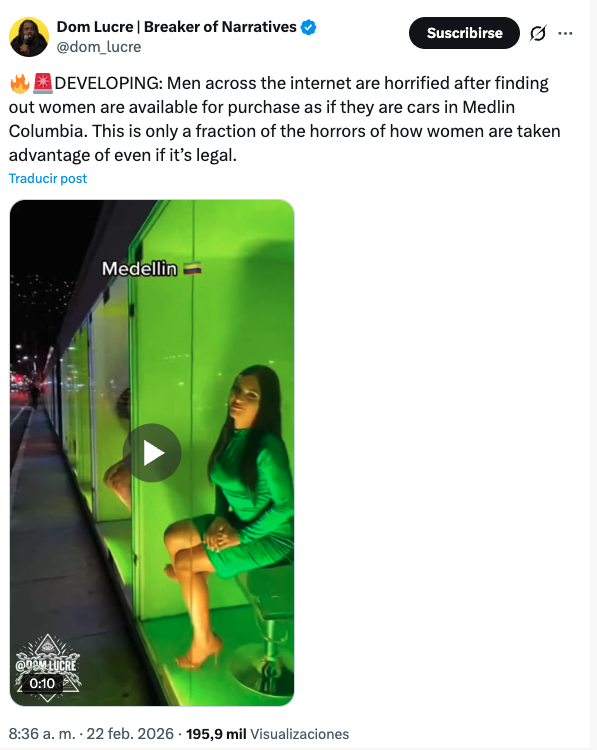
The virality hunters: Accounts like @dom_lucre, @kalletiRey, and others take the video, republish it (sometimes adding their own watermark), and distribute it across other platforms where it reaches millions. These accounts operate independently from the producer but benefit from content engineered to go viral.
Key Republisher Accounts
Dominick McGee — @dom_lucre (X): A U.S.-based far-right influencer with 1.5 million followers and a monetized account on X. Self-described as “Breaker of Narratives,” McGee is one of the most prominent global figures in spreading disinformation for monetization. In 2023, he was temporarily suspended from X for posting child exploitation content and was reinstated by direct decision of Elon Musk. His February 22 post of the Medellín video, branded with his own watermark, was the second-earliest publication found via reverse search.
@kalletiRey (X): An anonymous Mexican account created in 2025 that shares polarizing content. According to its profile metrics, the Medellín video reached 8.5 million views through this account alone, making it the single largest source of views identified.
@polo_man404 (X): Posted the earliest version found on X (February 21, 3:52 p.m.), which was itself a republication of a TikTok video from the account Vivii_wayne — a profile that has since deleted all its videos.
Why This Matters Beyond One City
This case is not about Medellín. Medellín is one of at least ten cities that were fed into the same template. The implications are global and structural.
Women’s bodies as a scalable product. Bunny Honey Club did not create a single provocative video. It built an automated pipeline that produces content where synthetic women are displayed as merchandise, localized for cities around the world. The agency’s landing page claims responsibility for “over 10 billion views.” The objectification of women is not a side effect of the technology. It is the product being sold.
AI tools have no guardrails for this. Current generative AI models allow anyone to create realistic videos that display women in degrading contexts with no restriction, no ethical review, and no traceability. None of the AI tools used to generate these videos prevented their creation, despite the content explicitly reducing women to objects on display.
Platforms failed to act. Despite the videos showing obvious AI artifacts, none of the six platforms where they were published (X, Instagram, TikTok, Facebook, YouTube, Kwai) labeled them as AI-generated content or limited their distribution. The Medellín video reached over 9 million views before any form of verification was possible.
City reputations are now one prompt away from damage. Medellín — a city that has spent decades rebuilding its international image — was reduced to a degrading stereotype manufactured by an algorithm in Frankfurt. The same could happen to Dublin, Hanoi, Taipei, or any other city tomorrow. The template already exists.
Accountability is nowhere. Who is responsible for the reputational damage? The agency that produces the content? The accounts that viralize it for profit? The platforms that distribute it without labeling? The AI models that generate it without restrictions? Today, the answer is: no one.
Methodology
This investigation was conducted by HyperConectado using the following techniques: reverse video search, frame-by-frame, cross-platform account tracing across six social media networks, public business record verification (Google Business), domain-to-social-media profile link analysis, and open-source intelligence. No automated scraping tools were used, and no private accounts were accessed.
Deja un comentario